|
|||||||


| Sponsored Links (Register now to hide all advertisements) |
|
|
 |

|
Thread Tools | Display Modes |
 05-15-2013, 03:43 PM
|
#1 |
|
Senior Member
Join Date: May 2010
Location: Sarasota Florida
Posts: 612
|
 circuit breaker
I want to replace the glass fuse with a circuit breaker, I found one that takes the place of the glass fuse and is 30 amp but it states 12 volt, will it still work on a 6 volt system? Thanks
|

|

|
|
05-15-2013, 03:54 PM
|
#2 |
|
Senior Member
Join Date: May 2010
Location: Windy City
Posts: 2,919
|
Re: circuit breaker
Yes it will work on 6V. If there is a voltage rating on a breaker, it refers to the insulation and arcing resistance. You wouldn't use it on a higher voltage for safety reasons, but the 'trip' setting is independent of voltage. Using it on a lower voltage will not matter. It will still trip at the same rated amperage.
|
|
|
|
| Sponsored Links (Register now to hide all advertisements) |
|
|
|
05-15-2013, 03:59 PM
|
#3 |
|
Senior Member
Join Date: Nov 2011
Location: Woodstock, IL
Posts: 334
|
Re: circuit breaker
To split your question into two parts:
1) Yes, the circuit breaker is compatible with 6 volts. 2) It did not work for me. I was having issues where my roadster would run fine while moving. If a stop took too long (more than a minute), it would die. Open the hood, wait about 5-10 minutes for things to cool down and off I go again... until the next stop. After a bunch of trouble shooting (that I won't bore you with), it turned out it was the breaker. It got hot, it tripped. Let it cool off and back in business... until it got hot again. Took out breaker, put back in the glass tube fuse and no problems since. Bought a five pack of spare fuses to carry with - haven't used one of the spares yet. Your results may differ.
__________________
- bogie '31 (Mostly) Roadster |
|
|
|
|
05-15-2013, 04:35 PM
|
#4 |
|
Senior Member
Join Date: May 2010
Location: Windy City
Posts: 2,919
|
Re: circuit breaker
bogiediver brings up a good point- the thermal response characteristics. The cheap automotive glass-fuse replacement breakers are not ambient thermally compensated and will trip at a significantly lower point when hot. In addition, all bi-metallic snap breakers get 'tired'. When new they work at the rated amperage. After several trips the trip point permanently lowers. A 30A breaker tripped 20 times becomes a 20-25A breaker. The only fix is to replace the breaker. In all cases, a breaker responds more like a slo-blow or time delay fuse, not like a fast-acting simple element fuseable link.
This picture is a Type II. 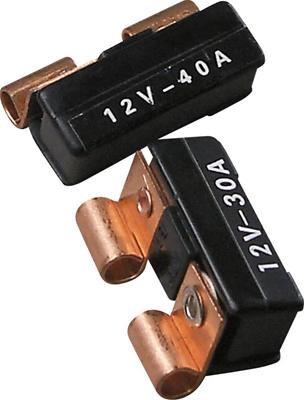 Types for low voltage auto breakers go like this- (From Littlefuse) Type I – Automatic Reset Cycles or continuously resets until the fault is corrected. Type I circuit breakers are typically used to protect circuits which occasionally experience momentary overloads such as wiper motor and headlamp circuits where a self resetting device is preferred. Type II – Modified Reset Non-cycling, remains in open position while there is power to the circuit. Resets when ignition is turned off. Type II circuit breakers are typically used in applications where fuse replacement is objectionable, such as power window, seat and sunroof circuits. Type III – Manual Reset Manually resettable circuit breakers remain in the open position until a button, lever or other external reset device is manually depressed. Type III circuit breakers are typically used in applications where a manual reset is desired for safe diagnosis of a circuit fault. |
|
|
|
|
05-15-2013, 04:55 PM
|
#5 |
|
Senior Member
Join Date: Jul 2012
Location: Hazzard County
Posts: 2,165
|
Re: circuit breaker
Agreed.
Not a good idea to use the thermal trip breakers in the Model A unless you mount them inside the car, and not to the firewall either. Fuses have a desireable trip characteristic- they will handle inrush currents (like turning headlights on) better than breakers. |
|
|
|
|
05-15-2013, 07:38 PM
|
#6 |
|
Senior Member

Join Date: May 2010
Location: Cape Cod
Posts: 1,129
|
Re: circuit breaker
Sponsored Links (Register now to hide all advertisements)
Fuses come in a number of different types : 1. Normal 2. Slow Blow 3. fast Blow Use the Slow Blow for loads with high in-rush current (motors) Use fast blow for sensitive equipment (solid state) Use normal for everything else. Marc |
|
|
|
|
05-15-2013, 07:49 PM
|
#7 |
|
Senior Member
Join Date: Dec 2010
Location: FRESNO, CA
Posts: 12,560
|
Re: circuit breaker
On Minerva, I used a 30 AMP G.M. bayonet type circuit breaker, with provided pig tail setup. Dangling in mid air above the starter. Worked well for years & simple! Bill W.
__________________
"THE ASSISTANT GURU OF STUFF" |
|
|
|
|
05-16-2013, 11:28 AM
|
#8 | |
|
Senior Member

Join Date: May 2010
Location: Florida between Sarasota and TampaSouth Florida
Posts: 14,054
 |
Re: circuit breaker
Quote:
__________________
What's right about America is that although we have a mess of problems, we have great capacity - intellect and resources - to do some thing about them. - Henry Ford II |
|
|
|
|

|
05-16-2013, 11:40 AM
|
#9 | |
|
Senior Member
Join Date: Jul 2012
Location: Hazzard County
Posts: 2,165
|
Re: circuit breaker
Quote:
|
|
|
|
|
|
05-16-2013, 12:24 PM
|
#10 |
|
Senior Member
Join Date: May 2010
Location: Windy City
Posts: 2,919
|
Re: circuit breaker
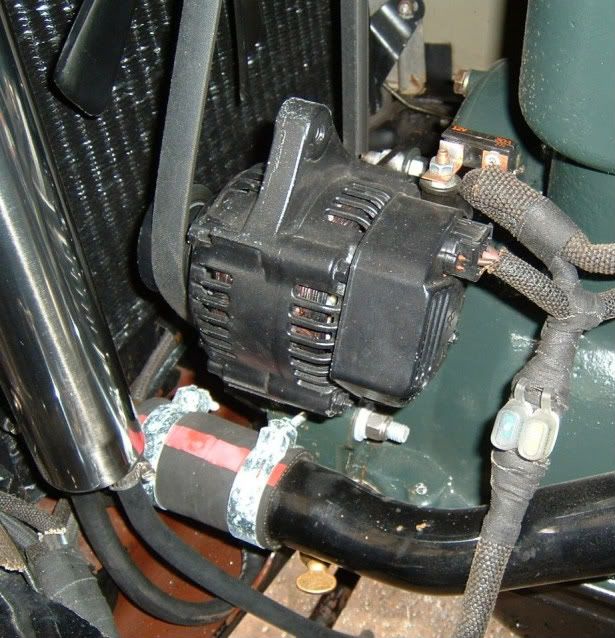
I've been running two in my 160B for years, no trouble. One 30A on the starter. I took a second 30A and unwound the round contacts to make two tabs in which I drilled holes. One tab is bolted directly to the output of my tiny Denso 3-wire alternator. No problems in 100F weather, but then I have never popped either breaker, so I can't comment on their repeat performance when hot.
|
|
|
|
|
«
Previous Thread
|
Next Thread
»
 Linear Mode

|
|

| Sponsored Links (Register now to hide all advertisements) |
|
|
All times are GMT -5. The time now is 06:31 AM.