Quote:
Originally Posted by TJ

A ride in a tri-Motor should be on everyone's bucket list. Was able to do it about 4 years ago and it was the thrill of a lifetime. As tubman says "the best $75 I ever spent". Actually at the time I would have paid twice that amount just to get the ride.
|
Most-assuredly, if you ever get the chance to ride in a Tri-Motor Ford, GO! I rode on my first one at Oshkosh in 1981...yup, the year of the controllers' strike while Oshkosh was going-on. I remember back then, it cost $15 to go around the patch in that noisy old rattling Ford.
More to the subject at hand, the Ford 15P. I remember talking about this airplane on this forum some time in the distant past. It surely was different, to say the least. Some beautiful metal-pounding for sure by talented artisans, with such talents being very rare today.
A couple of folks here have commented that there was no fin, no rudder and no (vertical) stabilizer. Well guys, the old YB-49, as well as today's B-2 and now the new B-21 are all what we commonly refer to as a "flying wing", and their stable flight, especially the current models, is well under control in the 'YAW' axis via "drag rudders", mounted on the outboard, rear of each wing, as is stated in the accompanying article on the "P15"....click the link BELOW.
https://oldmachinepress.com/2016/04/...onal-aircraft/
A couple of you even suggested that the "P15" never even flew, which is incorrect. The airplane made several flights sometime after early 1936, all flown by Ford head pilot Harry Russell.
Ever since the early '60s, I have heard tell of 10 "special" aluminum Ford flathead blocks that were produced for aircraft applications. This "P15" apparently got one of those special critters. The one detailed picture of the engine shows some interesting features for us flathead aficionados to ponder.
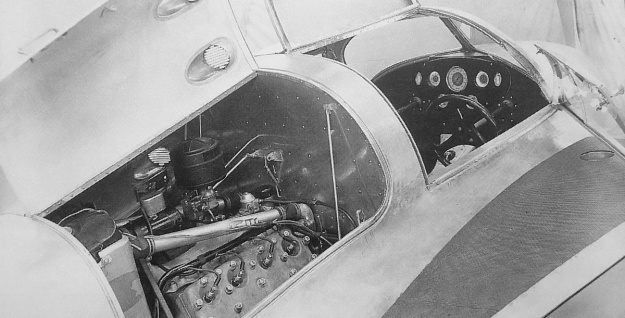 Click the link BELOW for a LARGER, more-detailed picture.
https://oldmachinepress.files.wordpr...15p-engine.jpg
Click the link BELOW for a LARGER, more-detailed picture.
https://oldmachinepress.files.wordpr...15p-engine.jpg
The heads appear to be the pump-in-head type currently in use on Ford cars at the time (1936), mounted backwards. The fuel pump location should define the "rear" of the engine. In addition, drive duties should always be undertaken by the flywheel end of the crankshaft. Furthermore, the angle of the fan belt suggests that two later style water pumps were in use to circulate water. One other note is that the propeller is pitched such that it must turn in the NON-STANDARD, reverse direction of clock-wise as seen while facing the aircraft from the front. The normal flathead crankshaft rotation would be counter-clockwise as seen while facing the aircraft. But alas, MOST propellers can't stand to be turned at the crankshaft speeds that the flathead was capable of turning. Therefore, it is most-likely that there was a geared-reduction box in the system, therefore necessitating the propeller to be of the reverse-pitch variety. I would be interested in seeing any additional pictures that anyone may have of this aircraft, or additional history on it's eventual demise.
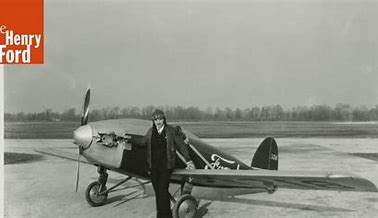
It should be noted here that this airplane had nothing to do with an aircraft known as "Ford's Flying Flivver". That was an aircraft that Ford was developing ten years earlier to "put a Ford airplane within every man's reach". It crashed off the Florida coast as a result of a toothpick being placed in a fuel cap vent hole by it's Ford pilot Harry Brooks, and forgotten. DD
Brooks & The Flivver
.